Activated Carbon for API Purification
In the manufacture of active pharmaceutical ingredients (API), the purity of the final product is a non-negotiable parameter. APIs that do not meet purity standards set out in international pharmacopoeias (Ph. Eur., USP, JP) may be rejected by regulatory authorities, leading to economic and supply chain consequences.
The activated carbon has become one of the most effective purifying agents in the API industry due to its unique ability to selectively remove organic impurities, colored compounds, residual metal catalysts and degradation byproducts without introducing additional contaminants into the treated product.
What is an API and why is its purification decisive?
An API is the pharmacologically active substance contained in a medicine. It is the component that produces the desired therapeutic effect. The synthesis of an API – whether by chemical, fermentative, semi-synthetic or biotechnological means – inevitably generates impurities that must be eliminated before the final formulation. These impurities can be classified into:
- Organic impurities: unreacted raw materials, reaction by-products, degradation products, synthesis intermediates and residual reagents.
- Inorganic impurities: metal catalysts (Pd, Pt, Ni, Ru, Rh), inorganic salts, precipitation reagents and heavy metals from process equipment.
- Residual solvents: organic solvents used in the synthesis and crystallization stages (methanol, acetone, ethyl acetate, dichloromethane, toluene, etc.).
- Chromophoric impurities: Compounds that give color to the API solution, although not toxic, affect the appearance and acceptance of the product.
The ICH Q3A (Impurities in New Drug Substances) guideline establishes strict reporting, identification and qualification thresholds for each impurity based on the maximum daily dose of the API. Activated carbon acts as a purification tool in the downstream processing, between the synthesis of the crude API and its final crystallization or drying.
Mechanism of action of activated carbon in API purification
Activated carbon purifies by Physical adsorption, a surface phenomenon in which impurity molecules are retained in the pores of coal by intermolecular Van der Waals forces. The extraordinary specific surface area of a quality activated carbon – between 800 and 1300 m²/g, determined by the BET method – provides a retention capacity that no other conventional adsorbent achieves.
In the specific context of APIs, adsorption on activated carbon is effective for:
- Low to medium molecular weight organic molecules (MW 100–800 Da): synthesis by-products, unwanted isomers, starting impurities, over-reaction products.
- Aromatic and conjugated compounds: Many process dyes and colored byproducts possess conjugated π systems that interact strongly with the graphitic surface of activated carbon.
- Metallic species in solution: The oxygenated functional groups present on the carbon surface (carboxyls, lactones, phenols, quinones) can chelate metal ions, contributing to the reduction of residual catalysts below the ICH Q3D limits.
- Compounds with hydrophobic character: The surface of activated carbon is essentially non-polar, which favors the adsorption of hydrophobic molecules over hydrophilic ones in aqueous media.
Applications of activated carbon in the different stages of API manufacturing
Decolorization of crude API after synthesis
The most frequent stage of application of activated carbon in the manufacture of API is the decolorization of the raw product or crude API. After chemical synthesis—especially in reactions that involve high temperatures, acidic media, or metal catalysts—the API solution has a color that ranges from pale yellow to dark brown.
Treatment with powdered activated carbon (PAC), followed by clarifying filtration, returns to the solution a transparency and color in accordance with pharmacopeial specifications.
Removal of residual metal catalysts
Catalytic hydrogenation reactions, cross-coupling (Suzuki, Heck, Negishi, Buchwald-Hartwig), and other transition metal-mediated transformations are ubiquitous in the synthesis of modern APIs. These processes leave traces of palladium, platinum, rhodium, ruthenium, nickel or copper in the product. The ICH Q3D guideline (Guideline for Elemental Impurities) classifies these elements according to their toxicity and establishes permitted daily exposure (PDE) limits.
Activated carbon, especially acid-treated, low-ash grades, acts as a complementary adsorbent to scavenger primary (chelating resin, carbon on support, etc.) to reach the required limits.
Purification of synthesis intermediates (GMP Intermediate)
In long synthetic routes—common in highly complex APIs such as oncology, antivirals or immunosuppressants—synthetic intermediates also require purification.
Treatment with activated carbon in intermediate stages allows the purity required for the next stage to be achieved without dragging impurities that would be magnified in subsequent steps. This is particularly relevant in intermediates regulated under GMP (ICH Q7).
Removal of residual solvents and volatile organic compounds
Although distillation and vacuum drying are the primary methods to reduce residual solvents (Class 2 and Class 3 according to ICH Q3C), activated carbon can contribute to the removal of traces of organic solvents in aqueous solution or in hydroalcoholic mixtures, especially when processed in a fixed bed column on an industrial scale.
Assisted crystallization and control of polymorphs
In some API crystallization processes, the presence of traces of organic impurities can inhibit the nucleation of the desired polymorph or favor the formation of an undesired polymorph.
The removal of these impurities by activated carbon before crystallization contributes to more robust polymorphic control, a critical aspect given that different polymorphs can have radically different bioavailabilities.
Types of activated carbon commonly used in API purification
The types of activated carbon most used in pharmaceutical applications are, among others:
Powdered activated carbon

Powdered activated carbon is the preferred choice for most active pharmaceutical ingredient (API) purification processes.
Advantages:
- Fast adsorption
- High contact efficiency
- Easy mixing in liquid systems
- Suitable for batch purification
Wood-based activated carbon powder is commonly used due to its developed mesoporous structure and excellent decolorizing ability.
Granular activated carbon
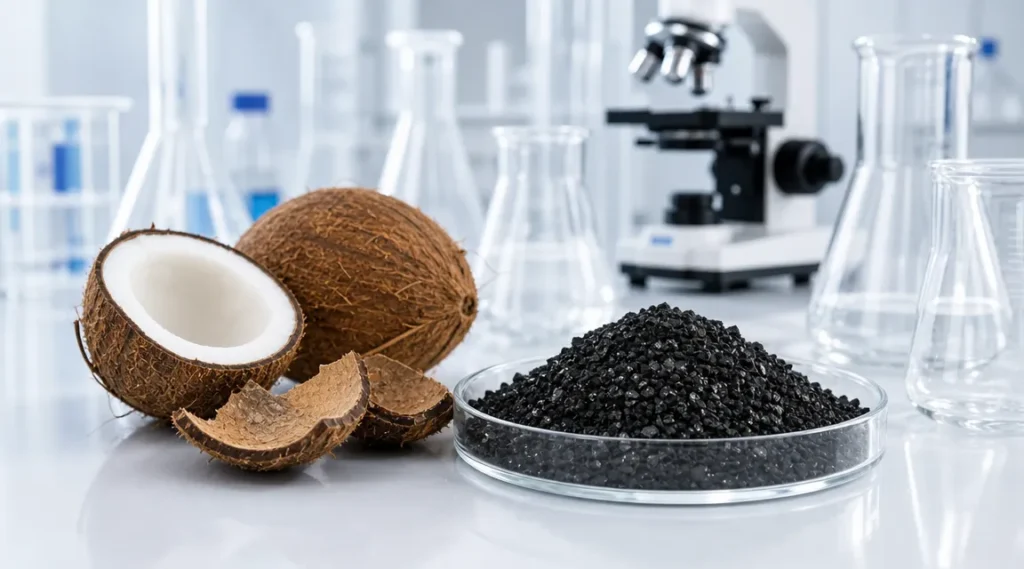
Granular activated carbon is commonly used in the purification of APIs within continuous filtration systems or as a post-treatment step to further remove trace impurities and residual organic matter.
It offers the following advantages:
- Easy to load and replace
- Suitable for continuous flow processes
- High mechanical strength, resistant to spraying
- Low pressure drop and stable operation
- Regenerable, reducing long-term costs
For pharmaceutical systems requiring long-term continuous operation, high-purity, low-ash granular activated carbon provides stable adsorption performance and reduces the frequency of system maintenance.
Key parameters to consider when choosing activated carbon for API purification
Selecting the right activated carbon is critical to the success of pharmaceutical products. Important specifications include:
| Parameter | Importance |
|---|---|
| Purity | Avoid pollution |
| Ash content | Lower ash content improves product quality |
| Heavy metal content | Essential for regulatory compliance |
| Surface area | Determine the adsorption capacity |
| Particle size | Affects filtration efficiency |
| pH | It must be compatible with the process conditions |
| Extractable substances | They should be minimal |
Conclusion
Activated carbon plays a critical role in the purification of active pharmaceutical ingredients (APIs), and the selection of suitable high-purity activated carbon can significantly improve the efficiency of pharmaceutical processes and the quality of the final product.
Don't hesitate to contact contact with us to request free samples and customized solutions.