Activated Carbon for Reverse Osmosis
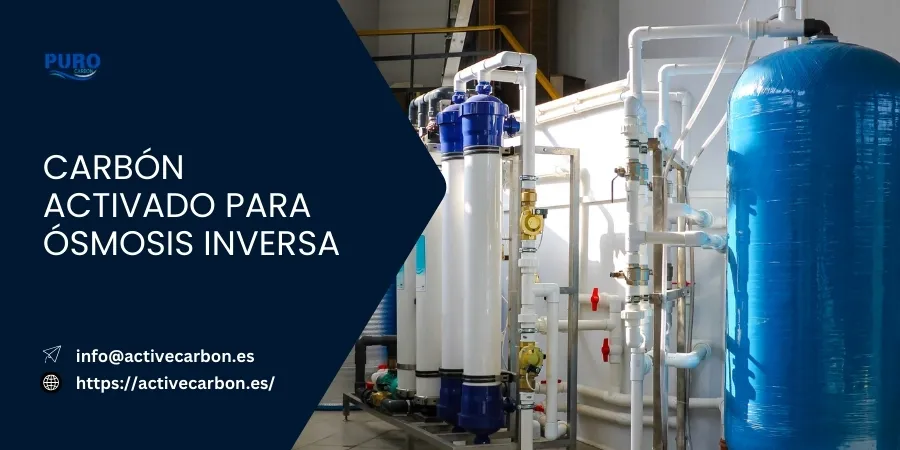
Reverse osmosis technology is one of the most effective methods for water purification in industrial, commercial and municipal applications. However, reverse osmosis membranes are extremely sensitive to various contaminants, such as chlorine and organic substances, which can cause scale formation.
Activated carbon, thanks to its excellent adsorption properties, offers outstanding performance in reverse osmosis technology. In this article we will discuss the role of activated carbon in reverse osmosis systems to help you choose the right product. activated carbon more suitable.
What is reverse osmosis technology?

Reverse osmosis is an advanced water treatment technology that uses semi-permeable membranes and the principle of pressure difference to achieve deep water purification.
In this process, water molecules pass through the extremely fine pores of the semipermeable membrane under pressure, while contaminants such as dissolved salts, organic matter, bacteria and viruses are retained on one side of the membrane.
This separation mechanism can achieve an impurity removal rate of up to 99%, making reverse osmosis one of the most efficient water purification methods currently available.
Reverse osmosis technology is widely applied in various fields:
- Seawater desalination: Conversion of seawater into freshwater resources
- Industrial water treatment: Supply of high purity water for various industrial processes
- Drinking water purification: Removal of trace contaminants from tap water
- Medical and pharmaceutical industry: Production of ultrapure water for medical equipment and drug manufacturing
- Food and beverage industry: Supply of production water that meets quality standards
The role of activated carbon in reverse osmosis systems
Activated carbon plays a vital role in reverse osmosis systems. Its high adsorption capacity and chemical properties make it an important barrier to protect reverse osmosis membranes.
Reduction of contamination and membrane clogging
Activated carbon effectively removes organic matter from water, which is the main cause of biological contamination in reverse osmosis membranes, thus reducing the formation of biofilms.
In addition, activated carbon can adsorb colloidal substances and suspended particles in the water, preventing them from accumulating and depositing on the surface of the reverse osmosis membrane, reducing the risk of clogging of the overall system.
Improved quality of produced water
Activated carbon is particularly effective at removing substances that cause abnormal odors and colors in water, such as:
- Pesticide residues
- Industrial solvents
- Methylisoborneol (MIB) and geosmin (algal metabolites)
- Disinfection byproducts (such as trihalomethanes)
These substances, even in very low concentrations, can affect the sensory quality of the water produced. The use of activated carbon ensures that the water produced by the reverse osmosis system is not only safe, but also tastes good.
Extending the life of reverse osmosis system components
By removing harmful substances, activated carbon not only significantly extends the life of the reverse osmosis membrane, but also that of other system components:
- Reduction in membrane cleaning frequency: Decreased damage to membranes due to chemical cleaning
- Protection of high pressure pumps: Reduction of abrasive particles in water
- Reduced energy consumption: Clean membranes require lower operating pressure, saving energy
Reduction of operating costs
Although adding activated carbon pretreatment requires an initial investment, in the long term it significantly reduces the total cost of ownership of reverse osmosis systems by:
- Reduction in the frequency of membrane replacement (generally the most expensive component in reverse osmosis systems)
- Reduction in the use of cleaning chemicals
- Reduced downtime and maintenance needs
- Improved system water recovery rate
Types of activated carbon for reverse osmosis systems
The types of activated carbon used in reverse osmosis systems are diverse, each with unique characteristics and application scenarios. Choosing the right activated carbon is crucial to optimize the pretreatment effect of the reverse osmosis system. Below are the main types of activated carbon commonly used in reverse osmosis systems:
Granular activated carbon

Granular activated carbon
Large-scale supply, large adsorption capacity and high mechanical strength, ensuring the safety of water quality.
Granular activated carbon is the most widely used type in the pretreatment of reverse osmosis systems, especially suitable for large-scale industrial and municipal water treatment facilities.
Features and benefits:
- Adsorption Capacity: It has a strong adsorption capacity, capable of effectively removing residual chlorine, odors, color and part of the organic matter from water.
- Regenerability: Granular activated carbon can be regenerated and reused multiple times, suitable for long-term operation systems.
- Low resistance to water flow: Due to the larger particle size, the resistance to water flow is lower, ensuring higher flow rates.
- High durability: Suitable for large-scale water treatment.
Application scenarios:
- Prefiltration in domestic water purifiers.
- Pretreatment in industrial reverse osmosis systems, used to remove residual chlorine and protect reverse osmosis membranes.
- Elimination of odors and organic contaminants in the treatment of drinking water.
Powdered activated carbon

Powdered activated carbon
Fast adsorption speed, excellent performance, high value for money and customization service available.
In powder form, with small particle size. Due to its large specific surface area, the adsorption rate is fast, capable of quickly removing contaminants from water.
Features and benefits:
- Greater efficiency in the elimination of small contaminating particles and dissolved organic matter.
- Ability to significantly reduce contaminant levels in water in a short period of time.
- Relatively low cost, suitable for single-use applications.
Application scenarios:
- Emergency treatment when water quality is severely contaminated or there is sudden contamination.
- Used in drinking water plants to remove dissolved organic matter, odors and color.
- Used for deep purification in industrial wastewater treatment.
PuroCarbon, as a professional activated carbon supplier, offers high quality activated carbon for reverse osmosis technology, improving the quality of produced water.
Conclusion
Activated carbon is a key component in reverse osmosis systems, capable of significantly extending the life of reverse osmosis membranes and improving the quality of the water produced.
With over 18 years of industry experience, PuroCarbon offers customized activated carbon solutions for various reverse osmosis applications. If you are looking for high quality activated carbon products, don't hesitate to contact us at.